

The Truth About How the Body Holds Emotion
By Brenda Stephens, Licensed Professional Clinical Counselor
How emotional trauma from narcissistic abuse lives in muscle memory and what neuroscience reveals about release and recovery.
If you’ve ever said, “I feel it in my body,” you’re not wrong.
Survivors of narcissistic abuse often describe tension that will not release, a stomach that clenches without warning, or exhaustion that outlasts the relationship itself. While it is common to talk about “stored emotions,” that phrase is more symbolic than scientific. Yet there is real truth underneath it.
When the body lives under constant psychological threat, it does not just remember, it reorganizes. Muscles brace. Breathing shortens. The vagus nerve goes quiet. Digestion slows. These are not signs of weakness; they are survival responses. The body learns to protect you, even after you have left the danger behind.
So when we say emotions are “held” in the body, what we are really noticing are the echoes of those protective patterns. They are not memories to excavate; they are reflexes that need soothing.
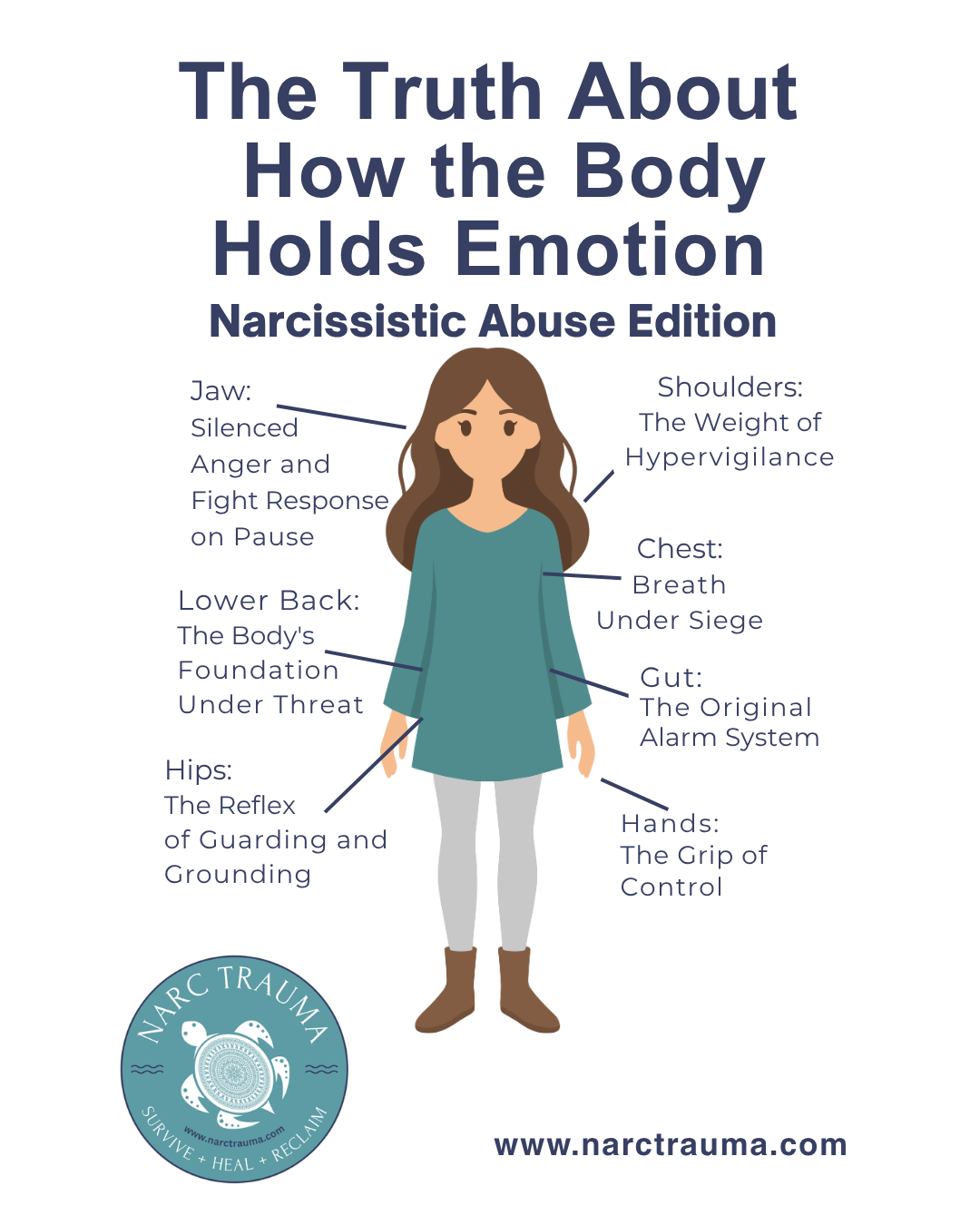
Where the Body Tells the Story
Hips: The hips are home to large stabilizing muscles that tighten when we freeze or prepare to flee. Survivors often cry during hip stretches because those muscles are finally releasing the years spent braced for impact.
Shoulders: These are the body’s alarm bells. Constant vigilance, predicting tone, tracking moods, preventing outbursts, all keep them lifted and tense. Lowering the shoulders becomes a small act of nervous system retraining, a physical reminder that it is safe to rest.
Lower Back: Chronic uncertainty, whether financial, emotional, or relational, often shows up here. When life feels unstable, the back tenses to compensate. As safety rebuilds, strength follows.
Jaw: When it was not safe to speak truth, your body learned to hold that silence. Jaw clenching and grinding are signs of the fight response being suppressed. Finding safe ways to express yourself, like talking, singing, or humming, helps the body trust its own voice again.
Chest: Shallow breathing and pressure in the chest often follow emotional cruelty or heartbreak. That tightness is not weakness; it is disrupted vagal tone. Slow, rhythmic breathing helps restore the body’s natural rhythm of safety.
Gut: The gut-brain axis gives this one scientific backing. Narcissistic abuse floods the system with cortisol, changing digestion and microbiome balance. “Gut feelings” are real; they are your nervous system talking through your stomach.
Hands: Many survivors learn to grip life tightly to control, fix, or prevent chaos. The same muscles that clench emotionally clench physically. Releasing that grip, both literally and figuratively, becomes part of the healing process.
Knees: Sometimes the body hesitates to move forward. Tightness or stiffness can mirror that inner resistance. Movement therapy and trauma-informed yoga can help the body relearn forward motion without fear.
Reclaiming Safety in the Body
The goal is not to find where sadness hides but to teach the body that it no longer has to brace for danger. Somatic therapies, breathwork, and grounding practices can help retrain the nervous system to recognize safety again.
Symbolism gives us language for the body’s wisdom. Science explains the mechanisms behind it. Together, they tell the same story: the mind endured it, but the body carried it, and both deserve healing.
If this resonated with you
Explore The Trauma Toolbox located on www.narctrauma.com or www.stephenstherapy.com if you need to be careful about the name of the websites you visit (iykyk) for in the heat of the moment practical somatic tools, grounding exercises, and nervous system regulation strategies created for survivors of narcissistic abuse to use in moments of chaos (or whenever you need it).
And join me on the podcast Two Queens and a Joker: My Narcissist’s Ex and Me where real stories meet clinical insight, and we talk about what healing actually looks like after narcissistic abuse. Hosted by myself and Sara, my narcissist’s other ex.