

Humbert, Dave, and the Problem of Cruelty
By Brenda Stephens, Licensed Professional Clinical Counselor
A hummingbird and a dove live in my backyard.
They have abundance. More than one feeder each. Consistent food. No lean season where the supply disappears. Nobody is starving. Nobody is at risk.
And yet.
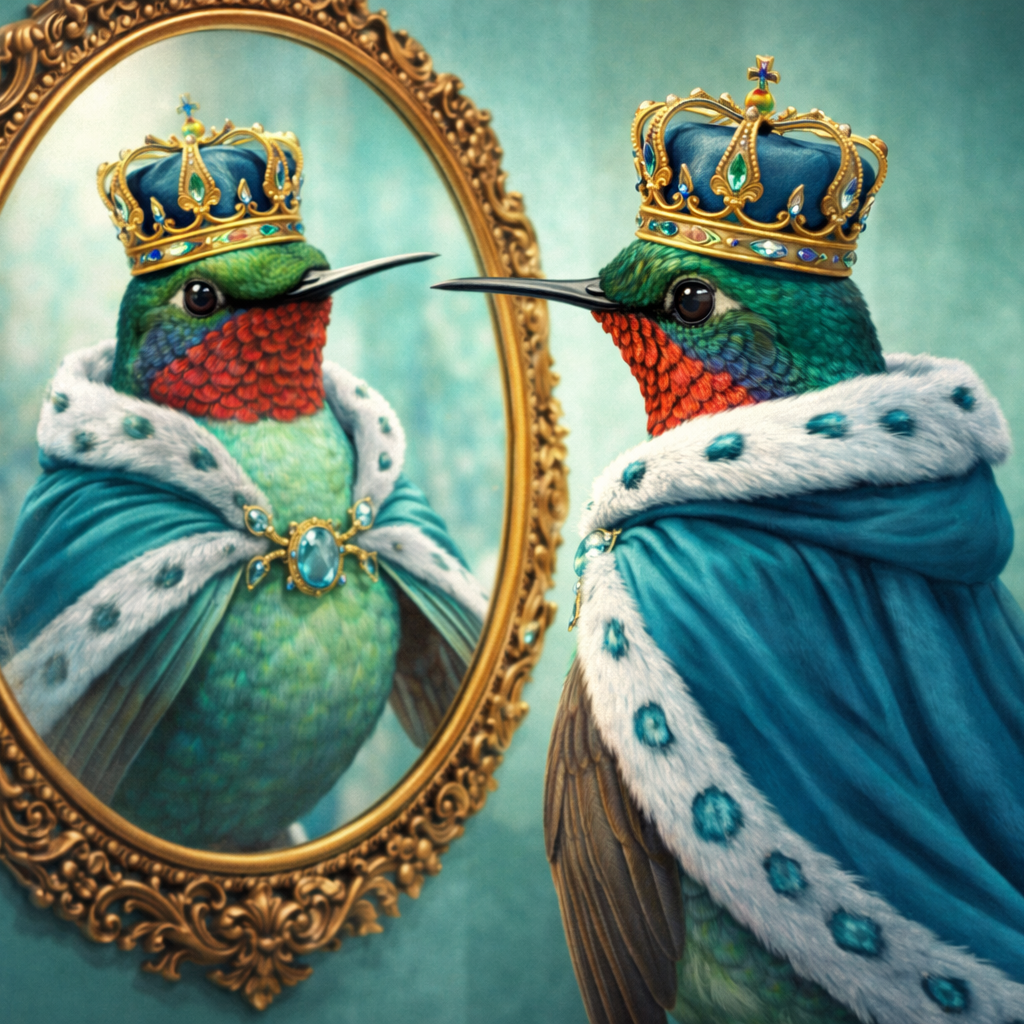
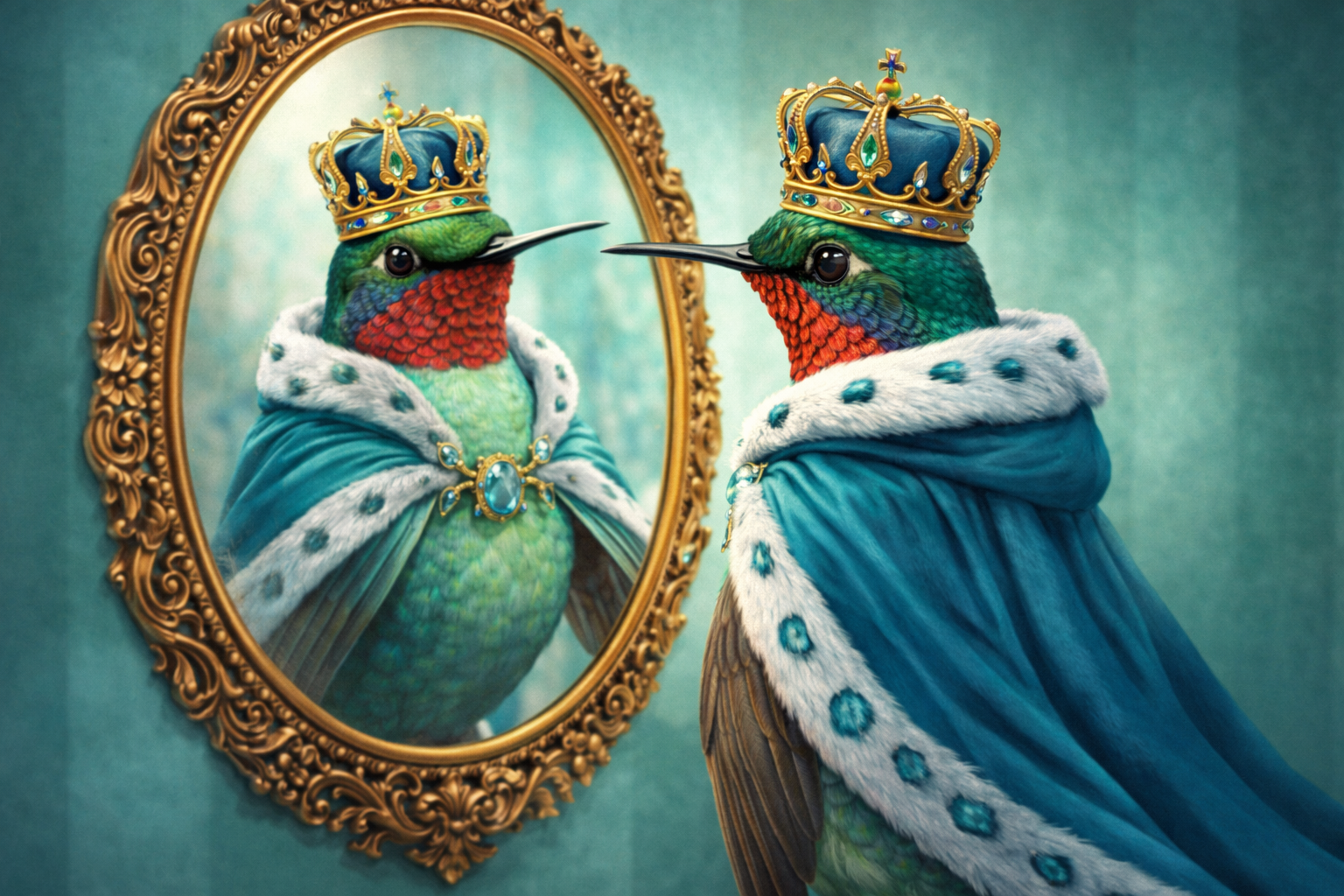
Humbert, the hummingbird, will perch and wait, not to eat, but to guard. When another hummingbird approaches, he dive bombs them like a tiny jeweled bouncer with a personal vendetta. Dave, the dove, does his own version: posturing, crowding, pushing. Sometimes they chase others away even when they are not trying to eat.
It is weirdly haunting, because it mirrors a human question that shows up in therapy offices, kitchens, divorce court, and late night doom scrolling.
How do narcissistic and cruel people exist in the world, even when there is plenty to go around?
This piece is an attempt to sit with the existential reality without flinching, and to use nature as a grounded analogy, not a moral excuse.
First, a reality check: this is not animal narcissism
When we watch animals, it is tempting to translate their behavior into human motives. It helps our brains make sense of chaos. But narcissism is a human psychological construct. Birds are not running an ego defense system. They are running survival and reproduction programs shaped by evolution.
Still, the analogy holds in a specific way: aggression and hoarding can show up even in abundance.
That part is real.
Why a hummingbird would guard a feeder that never runs out
In the wild, nectar is not stable. Flowers bloom, fade, get emptied, and are scattered across space. Hummingbirds also have extremely high energy needs and live close to the edge metabolically. Many species evolved intense territorial behavior around food sources, especially during breeding season.
What is striking is that this aggression can persist even when the rules change. Put out a feeder that stays full, and the bird can still behave as if scarcity is always one bad hour away. The instinct is deeply wired. It does not update instantly just because your backyard is running a reliable buffet.
So Humbert’s behavior makes sense in an evolutionary way, even if it looks irrational where the feeder never goes empty.
Dave’s version: dominance, access, and “why are you like this”
Feeders often become tiny social hierarchies. Some birds yield. Some posture. Some push. Some fight. It is not always the biggest bird who wins. It is often a mix of size, confidence, timing, and persistence.
Here is the key concept: resource defense is a strategy. It costs energy, but if it works, it increases access to food and sometimes mates. In nature, that can be enough to keep the strategy alive across generations.
And here is the part that lands emotionally: sometimes the strategy keeps happening even when it is no longer necessary.
Animal personality is a real thing, and it matters for this analogy
Researchers have found consistent individual differences across many species. Some individuals are reliably more aggressive, bolder, or more reactive than others. Not just once. Not just in one context. Over time.
So it is not only the species. It can be that specific bird.
That maps uncomfortably well onto human experience: two people can have similar opportunities, even similar wounds, and one of them is still chronically exploitative and cruel. Not because they lack resources. Because their internal settings are different.
What this has to do with narcissistic and abusive people
Here is the bridge, and I want to be blunt because sugar coating this is how people get trapped.
Some humans relate to others the way Humbert relates to the feeder. They do not pursue connection, reciprocity, or shared reality. They pursue control of access.
Access to attention, to status, to money, to sex, and to emotional labor. The right to define what happened. The role of victim, hero, or judge.
And just like a territorial bird, they may defend their “resource” even when they are not using it. That is one of the most disorienting parts for survivors: the cruelty is not always about getting something practical. Sometimes it is simply dominance, punishment, or control for its own sake.
The existential gut punch is this: their inner world can be organized around scarcity, entitlement, and dominance even when external reality is stable.
Plenty does not cure someone who experiences life as a zero sum contest.
Will they change? The uncomfortable truth
People can change, including people with strong narcissistic traits. But change is not something you can carry for someone else. Change can’t be carried by one person. It requires the person doing harm to genuinely want to change and to do the work consistently.
That requires conditions that are often absent in relational abuse: accountability that is real, not theatrical. Motivation to lose power, not just reduce consequences. Willingness to tolerate shame without outsourcing it. Long term treatment engagement. And consistent behavioral evidence over time.
So here is the practical existential answer many survivors eventually arrive at:
Do not build a life around someone’s potential when their pattern is your reality.
That is not cynicism. It is contact with reality.
Coming to terms with it, without becoming hard
Acceptance here is not approving. It is seeing clearly.
- Stop asking “Why are they like this?” as your primary question. It keeps you tethered. A better question is, “What do their behaviors reliably predict?”
- Grieve the ordinary goodness that should have been there. A lot of suffering is not just what happened, but what never existed: mutuality.
- Treat patterns as data. People get stuck when they weigh words more than behavior. Patterns are the person you are actually dealing with.
- Accept that empathy is not a strategy for disarming abuse. Empathy is a beautiful human capacity. It is not a force field.
- Make peace with the fact that the world contains predators. Not movie villains. Relational predators. People who feed on confusion, guilt, and hope.
The goal is not paranoia. The goal is clarity.
The backyard takeaway
Humbert and Dave are not evil. They are birds. They are doing bird math.
But the metaphor is still useful: nature contains strategies that look like hoarding, bullying, and dominance even when there is abundance.
So when someone asks, “How can cruel people exist?” the most honest answer is:
Because they can.
Because some nervous systems and personalities are organized that way.
Because domination sometimes works in the short term.
Because insight is not guaranteed.
Because empathy is unevenly distributed.
Because consequences are inconsistent.
Because the universe is not a therapy office.
And the second most important answer is this:
You do not need them to change in order to be free.
If this resonates with you, you’re not alone. At the Narcissistic Abuse Recovery Center, we help survivors understand these complex dynamics, heal the emotional impact, and build healthier patterns moving forward.
Ready to Take the Next Step in Your Healing?
If this article resonated with you, you don’t have to navigate the aftermath of narcissistic abuse alone. Here are ways to connect, learn, and heal with us:
- Listen to the podcast: Dive deeper into these conversations on Two Queens and a Joker: My Narcissist’s Ex and Me. Every episode combines lived experience with professional insight to help you feel less alone.
Join a group:
- Healing happens in safe, validating spaces. Explore our specialized support groups for Survivors of Narcissistic Abuse (SoNA) https://narctrauma.com/s-o-n-a-support-group/, and ask us about other supports, including programs for those going through divorce and recovery after narcissistic abuse.
- High-Conflict Divorce & Separation Support Group
Leaving, divorcing, or being recently divorced from a narcissistic partner can feel like living in a fog machine. This online support group is a safe, compassionate space where you can talk with people who truly get it, rebuild your sense of self, and learn practical tools for staying grounded through the legal and emotional rollercoaster. https://narctrauma.com/high-conflict-divorce-separation-support-group/
- Work with a specialist: At NarcTrauma.com, I work exclusively with survivors of narcissistic abuse and have personally trained our therapists in working with survivors of narcissistic abuse. Whether through individual therapy, group programs, or guided resources, you’ll find tools to rebuild your sense of safety, self-worth, and identity.
You deserve to heal, reclaim your power, and build a future where connection is safe and real.
We specialize in helping survivors untangle the patterns of narcissistic abuse and recover their sense of self. Learn more at www.narctrauma.com.
Follow for support and resources:
Facebook: Narcissistic Abuse Recovery Center
TikTok: @narctraumarecovery
Instagram (Podcast): @2queensandajoker
Instagram (Recovery): @narcrecoverycenter
References (APA)
Bell, A. M., Hankison, S. J., & Laskowski, K. L. (2009). The repeatability of behaviour: A meta-analysis. Animal Behaviour, 77(4), 771–783. https://pmc.ncbi.nlm.nih.gov/articles/PMC3972767/
Briffa, M., & Sneddon, L. U. (2015). Animal personality as a cause and consequence of contest behaviour. Biology Letters, 11(3), 20141007. https://pmc.ncbi.nlm.nih.gov/articles/PMC4387495/
Carpenter, F. L. (1987). Food abundance and territoriality: To defend or not to defend? American Zoologist, 27(2), 387–399. https://academic.oup.com/icb/article-pdf/27/2/387/270900/27-2-387.pdf
Cornell Lab of Ornithology. (2009). Why do hummingbirds fight so much? All About Birds. https://www.allaboutbirds.org/news/why-do-hummingbirds-fight-so-much/
National Audubon Society. (2024, August 21). Why do hummingbirds fight so much? https://www.audubon.org/magazine/why-do-hummingbirds-fight-so-much
Rousseu, F., Charette, Y., Bélisle, M., & Garant, D. (2014). Resource defense and monopolization in a marked population of ruby-throated hummingbirds (Archilochus colubris). Behavioral Ecology and Sociobiology, 68, 869–877. https://pmc.ncbi.nlm.nih.gov/articles/PMC3967903/
Weinberg, I., Ronningstam, E., Goldblatt, M. J., Schechter, M., Maltsberger, J. T., & Yaseen, Z. S. (2022). Narcissistic personality disorder: Progress in understanding and treatment. Focus, 20(3). https://psychiatryonline.org/doi/full/10.1176/appi.focus.20220052
Weinberg, I., Ronningstam, E., Goldblatt, M. J., Schechter, M., Maltsberger, J. T., & Yaseen, Z. S. (2024). Can patients with narcissistic personality disorder change? A case series. Journal of Nervous and Mental Disease, 212(7). https://pubmed.ncbi.nlm.nih.gov/38949659/
Roberts, B. W., Luo, J., Briley, D. A., Chow, P. I., Su, R., & Hill, P. L. (2017). A systematic review of personality trait change through intervention. Psychological Bulletin, 143(2), 117–141. https://pubmed.ncbi.nlm.nih.gov/28054797/
d’Huart, D., & colleagues. (2023). Key insights from studies on the stability of personality disorders. Frontiers in Psychiatry, 14, 1109336. https://www.frontiersin.org/journals/psychiatry/articles/10.3389/fpsyt.2023.1109336/full