


When One Parent Has Narcissistic Traits
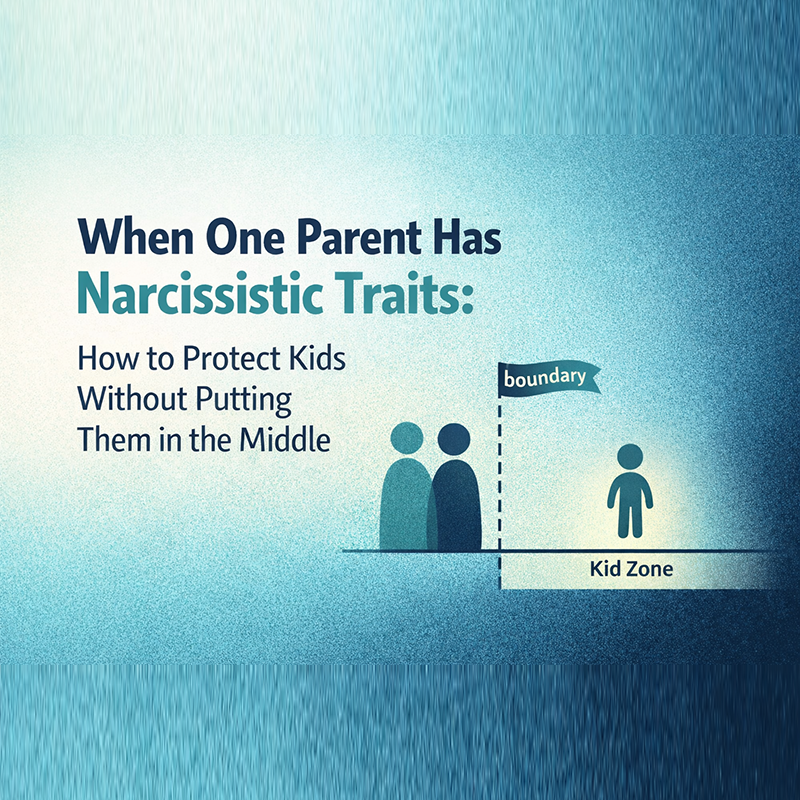
By Brenda Stephens, Licensed Professional Clinical Counselor
Co-parenting is hard when the other parent is defensive, image-focused, or uses conflict as fuel. It gets even harder when kids start carrying emotional weight that does not belong to them.
This article is for the parent who wants to do the right thing without turning their child into a messenger, a therapist, or a tiny lawyer.
A note on language: “narcissist” gets used casually online, but the diagnosis is clinical. Here, we’re talking about patterns that appear in high-conflict dynamics, including blame-shifting, guilt tactics, image management, and pressuring kids to take sides.
What the research says in plain English
The biggest driver of how kids do after separation is not the separation itself. It’s the level of ongoing conflict they are exposed to, and whether they have at least one steady, emotionally safe parent-child relationship.
So the goal is not “win co-parenting.” The goal is:
- Lower your child’s exposure to conflict
- Build emotional safety and predictability
- Teach your child skills for pressure moments
- Help them recover after transitions
That is a winnable plan.
What kids are up against in high-conflict dynamics
When one parent uses manipulation or intense self-focus, kids may experience:
- Loyalty binds: feeling forced to choose sides
- Role reversal: being treated like the parent’s comfort object or confidant
- Pressure to perform: saying what the parent wants to hear to keep the peace
- Adult information: being told details about court, money, dating, or the other parent
- Fear of consequences: the child learns that honesty triggers drama
These patterns are especially harmful because they shake a child’s sense of emotional safety in the family system.
The big principle: skills, not sides
Your child does not need a lecture about the other parent.
Your child needs a simple operating system for hard moments:
- Notice pressure
- Slow down
- Respond safely
- Recover
This protects them now and in the future.
What you can say to your child (the “no adult details” script)
Pick a language that fits your kid’s age. Keep it calm, short, and repeatable.
For younger kids (about 5 to 9):
“Both parents love you. Adults handle adult problems. Your job is to be a kid. If anything feels confusing, you can tell me and you won’t be in trouble.”
For older kids and teens:
“You never have to carry messages or take sides. If a conversation feels like it is about adult problems, you can step out. I will handle the adult stuff.”
Teach a “pause skill” for pressure moments
Many children in these homes learn that speed equals safety. They answer fast to avoid backlash. That makes them vulnerable.
Teach them a pause as a protection tool.
The Pause Skill (kid version):
- Take 3 slow breaths
- Drop shoulders
- Say one sentence: “I need time to think.”
Practice it like a fire drill. Not dramatic. Just normal.
Three kid-safe boundary phrases
Kids need boundaries that are respectful and boring. Boring is good. Boring does not feed conflict.
- “I’m not comfortable talking about Mom/Dad.”
- “I want to stay out of adult problems.”
- “I don’t know. I need time to think.”
Coach them to repeat the same sentence, calmly, and then change the subject or leave the room.
What to do after the other home: regulate first, talk later
Kids often crash after transitions. They may be snappy, shut down, clingy, or acting “fine” but tense.
Start with nervous system basics before questions:
- snack or meal
- shower or change clothes
- quiet time
- early bedtime if needed
- one predictable connecting moment (a walk, a show, a card game)
Then try:
“Do you want comfort, space, or words?”
The “Red Flag → Translation → What to do” framework
This keeps you out of debates and keeps your child grounded.
1) Red flag: “Your mom/dad is the reason for everything.”
Translation: “I want you aligned with me.”
What to do:
Tell your child: “Adults are responsible for adult choices.”
Reinforce boundaries: “You don’t have to agree. You can say ‘I’m staying out of it.’”
2) Red flag: The child becomes the messenger
Translation: “I don’t want direct accountability.”
What to do:
Tell your child: “You don’t have to deliver messages. If they need something, they can message me.”
Use a co-parenting app or email for essentials only.
3) Red flag: Big promises, no follow-through
Translation: “I need you to feel hopeful so you stop asking questions.”
What to do:
Teach your child: “We trust actions.”
Help them track reality gently: “What actually happened?”
4) Red flag: Victim pivots after being confronted
Translation: “If you question me, you are cruel.”
What to do:
Teach your child: “You are allowed to have feelings and still be kind.”
Practice: “I’m not trying to hurt you. I’m going to take a break.”
Co-parenting vs parallel parenting: choose what protects your child
Traditional coparenting requires collaboration. In high-conflict situations, trying to force can increase contact and intensify conflict.
A more protective approach is often parallel parenting, where communication is limited to essential child logistics, ideally in writing, and the plan is specific.
Important reality check: if there is abuse toward the child, you need legal guidance and safety planning. Parallel parenting is not a substitute for safety.
What helps kids long-term
You do not need the perfect coparent to protect your child. Protective factors are (and should be) boring and consistent:
- warm, steady connection
- effective limits and routines
- reduced conflict exposure
- predictable transitions
- letting kids be kids
Signs your child needs extra support
Consider professional support if you notice:
- sudden drop in school performance
- panic, sleep issues, stomach aches with no medical cause
- aggression, self-harm talk, or risky behavior
- dissociation or “zoning out.”
- intense fear about transitions
- the child believes they must manage a parent’s emotions
What not to do (even when you are right)
Hard truth: You can be correct and still harm your kid by how you communicate it.
Avoid:
- interrogations after visits
- venting about court or money
- asking the child to report what the other parent said
- labeling the other parent to the child
- using the child as your proof
The child’s nervous system will pick safety over truth every time. Your job is to make truth safe.
A simple weekly plan that works
- One connection ritual: same day, same time
- One “skills rep”: practice a boundary phrase or pause skill
- One emotional check-in: “comfort, space, or words?”
- One recovery support after transitions: food, rest, routine
This is boring, which is the point. Boring is stabilizing
Closing
You cannot control the other parent. You can control the emotional climate your child lives in with you.
When you build predictability, teach boundaries, and make repair normal, you give your child a blueprint for healthy relationships.
References
American Academy of Child and Adolescent Psychiatry. (n.d.). Children and divorce (Facts for Families No. 1).
American Psychological Association. (n.d.). Divorce and child custody.
Blueprints Programs. (n.d.). New Beginnings for children of divorce.
Kelly, J. B., & Emery, R. E. (2003). Children’s adjustment following divorce: Risk and resilience perspectives. Family Relations, 52(4), 352–362.
Sandler, I., et al. (2019). Randomized effectiveness trial of the New Beginnings Program.
van Dijk, R., et al. (2020). A meta-analysis on interparental conflict, parenting, and child adjustment in divorced families. Clinical Psychology Review, 79, 101861.
Wolchik, S. A., Sandler, I. N., et al. (2009). The New Beginnings Program for divorcing and separating families: Research on transportability and dissemination.
Gottman Institute. (2012). An introduction to emotion coaching.
Gottman Institute. (2019). Divorce is the most important story you’ll ever tell your child.
Lange, A. M. C., et al. (2021). Parental conflicts and posttraumatic stress of children in high-conflict divorce.
Parents. (2024). What is parallel parenting? Creating a plan for your family.
Verywell Family. (2021). How to create a parallel parenting plan that works for your family.